Before a website can open, DNS must translate its domain name into the correct IP address. Gigatech now uses global Anycast DNS, allowing DNS queries to be answered through a nearby and available network location. This generally provides faster DNS responses, greater redundancy and additional resilience.
At a glance
- Four public Anycast nameservers, available over both IPv4 and IPv6.
- Internet routing directs DNS queries to a suitable network location.
- Multiple locations provide redundancy if a route or site is temporarily unavailable.
- Zone data remains centrally managed and is synchronised across the Anycast network.
What is Anycast DNS?
With traditional Unicast DNS, an IP address normally points to one specific location. With Anycast, the same service address is announced from multiple locations on the internet. The network then uses the routes available at that moment to decide where a DNS query is handled. This is often a nearby location, although technically it is the best reachable route according to current routing.
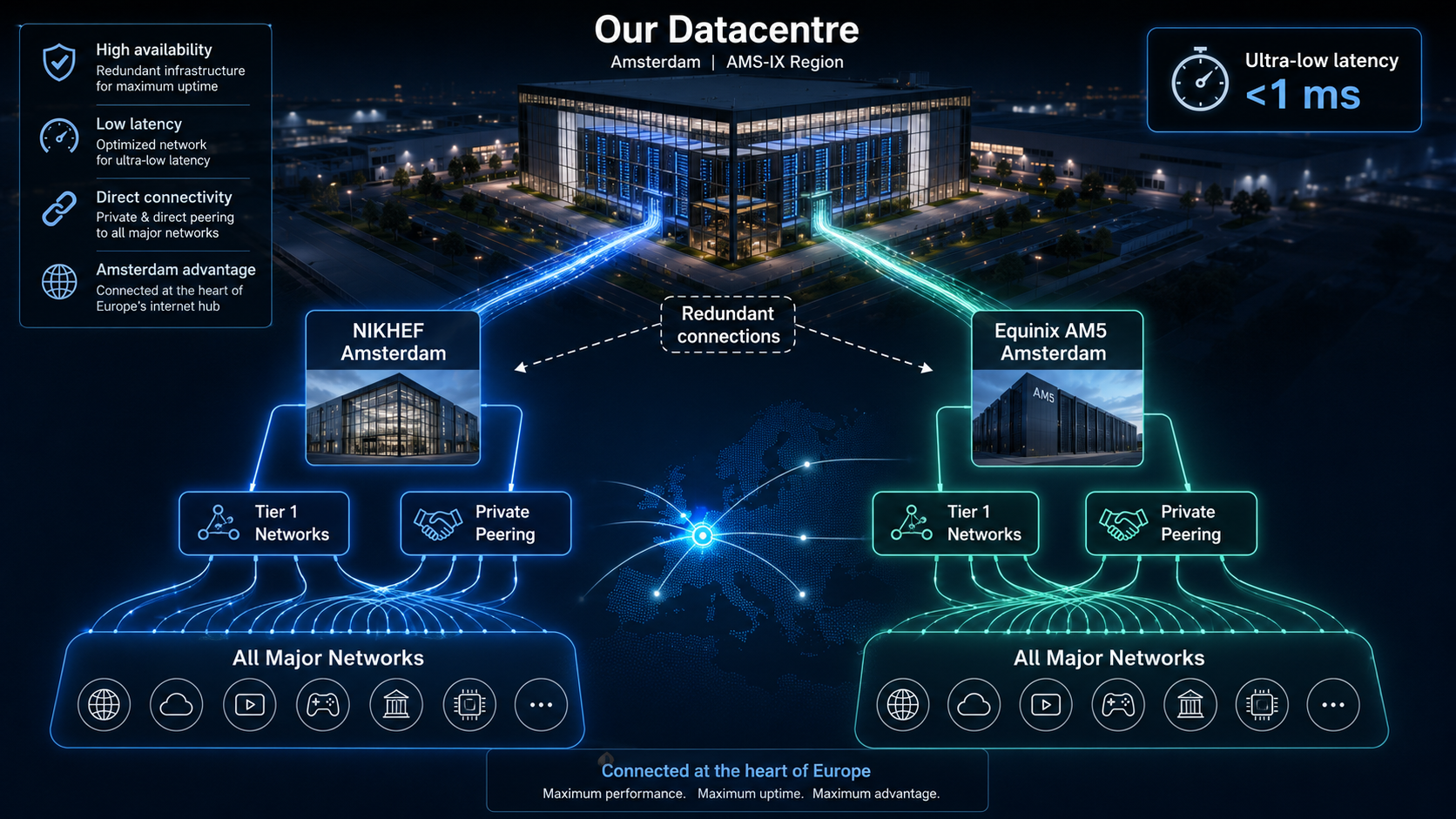
Because several locations provide the same DNS service, the network is less dependent on a single server or data centre. If a location or route becomes unavailable, traffic can automatically be handled through another available route. The official Anycast guidelines describe this model as one stable service address available from multiple locations.
What changed at Gigatech?
DNS zones for our hosting environment are centrally managed in WHM/cPanel. ClouDNS acts as Secondary DNS and synchronises the zone data to the global Anycast network. This retains one clear source of truth for DNS management while public queries are answered through distributed infrastructure.
The public nameserver set consists of four separate Anycast nameservers:
| Nameserver | IPv4 | IPv6 |
|---|---|---|
| pns71.cloudns.net | 45.83.248.12 | 2a06:fb00:2::1:12 |
| pns72.cloudns.com | 45.83.249.12 | 2a06:fb00:2::2:12 |
| pns73.cloudns.net | 45.83.250.12 | 2a06:fb00:2::3:12 |
| pns74.cloudns.uk | 45.83.251.12 | 2a06:fb00:2::4:12 |
The benefits of global Anycast DNS
1. Often a faster DNS response
A visitor does not always have to reach one distant, fixed nameserver location. Anycast can send a DNS query to a better reachable location. This can reduce DNS response time, particularly for visitors located farther away from the Netherlands. The actual effect varies by network, provider and route.
2. Greater availability through redundancy
The DNS service is distributed across multiple locations. A problem affecting one server, network route or location therefore does not necessarily stop DNS resolution for everyone. Traffic can be handled through another available route.
3. Distributed DNS traffic
DNS queries do not all arrive at one physical site. The distributed design helps spread load across the network and reduces reliance on a single bottleneck.
4. Additional resilience against attacks
A globally distributed network can absorb malicious traffic across multiple locations and adjust routes when necessary. This improves the DDoS resilience of the DNS layer. Anycast does not guarantee that every attack will be impact-free; monitoring, capacity and other security controls remain essential.
5. Full IPv4 and IPv6 support
All four nameservers are reachable over both IPv4 and IPv6. This supports modern networks without excluding legacy IPv4 connectivity.
Anycast DNS is not the same as a CDN
DNS determines where a domain name can be found. A CDN can subsequently deliver web assets such as images, scripts or complete pages from locations closer to visitors. Anycast DNS therefore primarily improves the initial lookup and the availability of the DNS layer. Final page speed also depends on hosting, application code, caching, TLS, HTTP/3 and, where applicable, a CDN.
That is why we combine the DNS layer with our hosting infrastructure and optimised WordPress hosting.
Secure synchronisation and controlled changes
The cPanel server remains the primary source of zone data. Changes to a DNS zone are transferred to the Secondary DNS environment in a controlled way. Before going live, we verify that zone versions match and that each public nameserver independently returns the correct answer.
When nameservers are changed, registries, providers and resolvers may temporarily cache old information. We therefore perform delegation changes in a controlled manner and, where necessary, allow old and new DNS routes to operate side by side for a transition period. This limits the risk of interruption during DNS propagation.
What about DNSSEC?
DNSSEC adds cryptographic validation that allows a resolver to verify that a DNS answer has not been modified in transit. It is a valuable additional security layer. The full chain must be configured correctly, from the signed zone to the DS record at the registrar. We therefore enable DNSSEC per domain through a controlled rollout; Anycast itself is not presented as a replacement for DNSSEC.
Frequently asked questions
Does Anycast make my website itself faster?
Anycast can speed up the DNS lookup, especially for visitors farther away. It does not automatically accelerate the application, database or images. Fast hosting, caching and possibly a CDN remain important for those elements.
Is Anycast DNS available worldwide?
Yes. The nameserver addresses are offered from multiple locations across the global network. The current internet routing determines which location a visitor reaches.
What happens if a DNS location fails?
If a route or location is no longer available, the network can direct DNS traffic through another available location. This is a key advantage over relying on a single site.
Does it work over IPv6?
Yes. All four public nameservers have both an IPv4 and an IPv6 address.
Do I need to change anything as a hosting customer?
For new or migrated domains, we will provide the nameservers that need to be configured at the registrar. DNS records remain managed through the usual hosting environment. If in doubt, contact us first so that we can check the current zone and delegation.
Ready for resilient hosting and DNS?
Would you like to know what Anycast DNS and our hosting infrastructure can do for your website? We will gladly review your current DNS setup and recommend a safe migration path.